
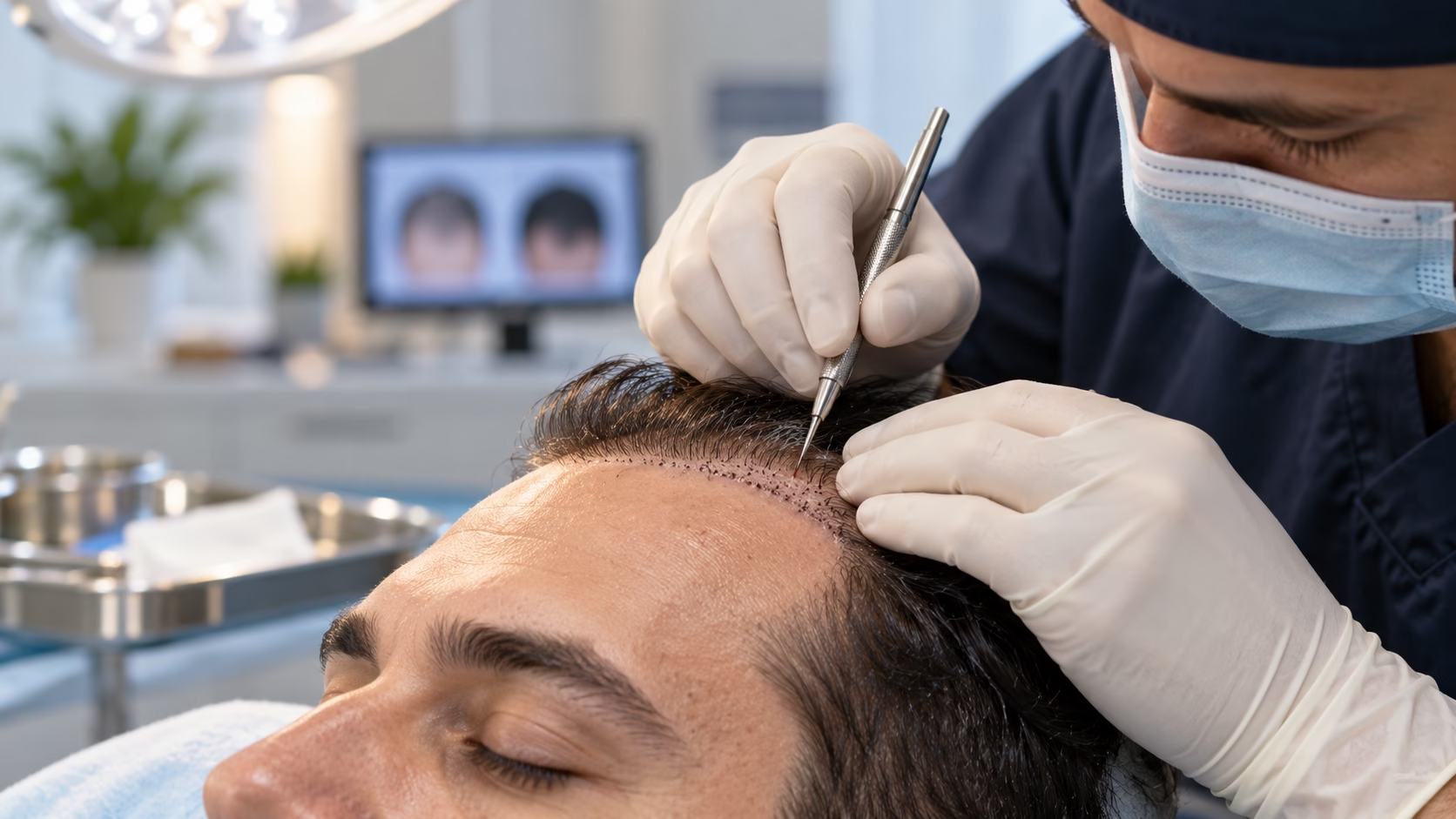
One of the first questions people considering a hair transplant ask is:
“How many grafts will I need?”
It sounds like a simple question, but there is no single number that applies to everyone.
Two people with apparently similar hair loss may require very different treatment plans because graft requirements depend on the size of the thinning area, donor hair availability, existing hair density, hair characteristics, future hair-loss pattern and the type of hairline being planned.
For anyone considering a hair transplant in Mumbai, understanding how graft requirements are calculated can help you approach treatment with more realistic expectations.
Dr. Kunal Sayani, MBBS, MS, MCh and DrNB (Plastic Surgery), provides aesthetic and reconstructive surgical consultations at his clinic in Vile Parle West, Mumbai, with hair transplantation included among the treatments offered at his practice.
What Is a Hair Graft?
A hair graft is a small unit of tissue containing one or more hair follicles that is transferred from the donor area to an area affected by hair loss.
A graft should not automatically be confused with a single hair.
One graft may contain:
- One hair
- Two hairs
- Three hairs
- Occasionally more hairs
The distribution of these grafts matters considerably when designing a natural-looking transplant.
For example, finer single-hair follicular units are often useful near the front hairline, while grafts containing more hairs may be strategically placed further behind to improve the appearance of density.
This means the number of grafts alone does not determine how natural or dense a hair transplant will look.
Planning and placement matter just as much.
Why Is There No Fixed Number of Grafts for a Hair Transplant?
Hair transplantation involves redistributing a limited supply of permanent or relatively stable donor hair.
The surgeon therefore has to balance two areas:
Donor Area
This is the area from which suitable hair follicles are harvested.
For many patients, this is primarily the back and sides of the scalp.
Recipient Area
This is the thinning or bald area where the follicles will be transplanted.
A good hair transplant plan should not simply remove the maximum possible number of grafts.
Instead, the goal is to use the available donor hair strategically while considering both the patient’s present appearance and potential future hair loss.
What Determines How Many Hair Grafts You Need?
Several factors influence the number of grafts required.
1. Size of the Bald or Thinning Area
The larger the area requiring treatment, the greater the potential graft requirement.
Someone with a small receding hairline generally requires a different number of grafts from someone with thinning involving:
- Hairline
- Frontal scalp
- Mid-scalp
- Crown
However, covering every thinning area in one session is not always the appropriate approach.
Donor availability and long-term planning need to be considered first.
2. Your Existing Hair Density
A completely bald area and a partially thinning area are different situations.
If there is still significant existing hair in the recipient area, fewer grafts may sometimes be required to create visible improvement.
However, the surgeon must also consider whether the existing hair is stable or likely to thin further.
Hair transplant planning should therefore evaluate both current hair loss and expected progression.
3. Donor Hair Availability
The donor area is one of the most important factors in hair transplantation.
The surgeon evaluates:
- Donor density
- Hair calibre
- Distribution of follicles
- Scalp condition
- Previous hair transplant procedures
- Potential for future harvesting
A person may want a very large number of grafts, but that does not mean the donor area can safely provide them.
Preserving the donor area is particularly important because it is a limited resource.
4. Hair Thickness
Hair calibre influences visual coverage.
Thicker hair can often provide more visual coverage than very fine hair because individual strands occupy more visual space.
This means two patients receiving the same number of grafts may achieve a different appearance of density.
5. Hair Colour and Scalp Contrast
The contrast between hair and skin can affect how dense the hair appears.
When there is significant contrast between dark hair and a lighter scalp, thinning may appear more noticeable.
When the contrast is lower, the scalp may sometimes be less visually prominent.
This does not determine whether someone is a good candidate for transplantation, but it is one of several characteristics considered when planning coverage.
6. Hair Curl and Texture
Straight, wavy and curly hair can create different patterns of scalp coverage.
Hair texture can therefore influence how the surgeon plans graft distribution.
The objective should be to work with the patient’s natural hair characteristics rather than using the same density pattern for everyone.
7. Your Hairline Design
Hairline design has a major influence on graft requirements.
A very low hairline requires more surface area to be covered and can therefore consume more grafts.
This may not always be appropriate, particularly for younger patients who could continue losing hair in the future.
A conservative, age-appropriate hairline may help create a natural appearance while preserving donor follicles for potential future requirements.
8. Your Age and Future Hair Loss
Hair loss may continue after a hair transplant.
Transplanted follicles and the patient’s original non-transplanted hair do not necessarily behave in the same way.
This is why planning should consider:
- Current age
- Pattern of hair loss
- Family history
- Stability of hair loss
- Existing miniaturised hair
- Likelihood of future progression
Using too much donor hair early without considering future loss can make later treatment more difficult.
Does One Graft Equal One Hair?
No.
This is an important distinction.
A graft may contain more than one hair follicle.
Therefore:
2,000 grafts does not necessarily mean 2,000 individual hairs.
The actual number of hairs depends on the follicular units harvested.
This is also why comparing clinics only by advertised graft numbers can be misleading.
The quality of the donor follicles, their survival, placement, direction, angulation and distribution are also important.
Is More Grafts Always Better?
No.
More grafts do not automatically mean a better hair transplant.
An excessively aggressive transplant can potentially compromise the donor area.
Hair transplantation should focus on achieving an appropriate balance between:
- Coverage
- Density
- Natural appearance
- Donor preservation
- Future hair loss
A well-planned procedure may use grafts selectively in areas that create the greatest visual improvement rather than attempting maximum density everywhere.
What Is Donor Area Overharvesting?
Overharvesting occurs when too many follicles are removed from a donor area relative to what that area can safely support.
This can potentially create:
- Patchy donor appearance
- Visible thinning
- Uneven density
- Increased visibility of extraction sites
- Reduced donor availability for future treatment
This is particularly relevant with follicular unit extraction techniques, where individual follicular units are removed.
International hair-restoration guidance also cautions that inappropriate FUE harvesting can lead to diffuse donor thinning and visible scarring.
A treatment plan should therefore consider the appearance of the donor area after extraction, not simply the number of grafts obtained.
How Does the Hairline Affect the Final Result?
The frontal hairline is usually one of the most visually important areas of a hair transplant.
Natural hairlines are not perfectly straight or mechanically uniform.
Hair direction, angle, density and irregularity all contribute to the final appearance.
A surgeon planning the hairline needs to consider:
- Facial proportions
- Forehead height
- Age
- Current hair-loss pattern
- Existing temporal recession
- Available donor hair
- Future hair loss
A hairline that looks appropriate at age 25 should also be considered in terms of how it may appear as the patient ages.
Hairline vs Crown: Where Should Grafts Go First?
This depends on the individual case.
For many people, frontal hair loss has a particularly strong effect on appearance because it frames the face.
The crown, however, can require a substantial number of grafts because of its surface area and natural spiral pattern.
When donor supply is limited, prioritisation becomes important.
Some patients may benefit from concentrating treatment on the frontal scalp rather than trying to create equal density across every area.
Others may have adequate donor supply to address multiple regions.
The decision should be made after examining the scalp rather than applying the same template to every patient.
Can the Crown Require More Grafts?
The crown can be challenging because the hair naturally grows in a whorl or spiral pattern.
Creating natural-looking coverage requires careful attention to:
- Hair direction
- Angle
- Existing crown pattern
- Area of thinning
- Donor availability
Attempting very high density across a large crown can use a substantial proportion of available grafts.
This is another reason long-term planning is important.
What Is FUE Hair Transplantation?
Follicular Unit Extraction (FUE) involves individually harvesting follicular units from the donor area.
The harvested follicles are then prepared and transplanted into recipient sites.
FUE avoids a long linear donor scar, but it still produces numerous small extraction sites.
The procedure should therefore not be marketed as completely “scarless.”
How visible extraction marks become depends on factors including technique, donor density, healing and hairstyle.
What Is FUT Hair Transplantation?
Follicular Unit Transplantation (FUT) involves removing a strip of hair-bearing scalp from the donor area.
Follicular units are then prepared from this tissue and transplanted into recipient sites.
FUT leaves a linear donor scar.
Both FUE and FUT are methods of obtaining donor follicles. The most appropriate approach depends on factors such as the patient’s scalp, donor characteristics, hairstyle preferences, previous procedures and treatment goals.
The harvesting method should not be chosen solely because one technique is marketed as newer.
Can Everyone Have a Hair Transplant?
No.
Hair transplantation is not suitable for every type of hair loss.
Assessment is important because hair loss may result from different conditions.
A surgeon may consider:
- Type of hair loss
- Pattern and progression
- Donor density
- Scalp condition
- Patient age
- General health
- Expectations
- Previous treatments
- Previous transplant surgery
A hair transplant generally requires an adequate donor area capable of supplying usable follicles.
Some patients may need further evaluation or non-surgical management before considering transplantation.
Can Young Patients Get a Hair Transplant?
Age alone does not provide a complete answer.
The concern with very young patients is that their pattern of future hair loss may not yet be established.
If a very low or aggressive hairline is created while natural hair continues to recede behind it, the patient may require additional procedures later.
The surgeon therefore needs to consider long-term progression, not merely the areas that look thin today.
How Is the Number of Hair Grafts Calculated?
During consultation, graft planning generally involves assessment of:
Recipient area × desired visual density × donor capability.
However, it is not simply a mathematical exercise.
The surgeon also evaluates:
- Existing hair
- Hair shaft thickness
- Follicular-unit composition
- Hair direction
- Donor density
- Hairline design
- Crown requirements
- Future hair loss
- Previous procedures
This is why an accurate graft estimate generally requires examination rather than relying on an online photograph alone.
Can a Hair Transplant Be Planned From Photos?
Photographs may be useful for an initial discussion.
However, photographs cannot always accurately show:
- Donor density
- Hair calibre
- Scalp condition
- Follicular distribution
- Degree of miniaturisation
- Skin characteristics
For surgical planning, an in-person examination usually provides considerably more information.
What Happens to Transplanted Hair After Surgery?
After transplantation, the scalp undergoes a healing period.
It is common for transplanted hair shafts to shed during the early period following surgery.
This does not necessarily mean the transplanted follicles have failed.
Hair growth develops gradually rather than immediately.
Patients considering transplantation should understand that hair restoration is a process measured in months rather than days.
Full maturation of results can take considerable time, and different areas may develop at different rates.
Why Hair Transplant Planning Matters More Than Graft Numbers
Advertising around hair transplantation often places considerable emphasis on numbers:
“Maximum grafts.”
“Unlimited grafts.”
“Mega sessions.”
However, graft quantity should not be considered separately from donor safety and long-term planning.
A responsible treatment plan should answer:
- Why is this number of grafts recommended?
- Which areas will receive them?
- What density is realistically achievable?
- How much donor hair will remain?
- What happens if hair loss progresses?
- Who is performing the surgical steps?
The International Society of Hair Restoration Surgery recommends that properly trained and licensed physicians remain responsible for diagnosis, surgical planning, donor harvesting, hairline design, recipient-site creation and post-operative medical care.
How Should You Choose a Hair Transplant Surgeon in Mumbai?
A hair transplant is a surgical procedure, not simply a cosmetic salon treatment.
When considering treatment, patients should evaluate:
- Medical qualifications
- Surgical training
- Experience with hair transplantation
- Who will actually perform the surgical steps
- Donor-area assessment
- Hairline planning
- Sterility and facility standards
- Discussion of risks
- Long-term planning
- Post-operative follow-up
You can learn more about Dr. Kunal Sayani’s qualifications and surgical background.
Hair Transplant Consultation in Vile Parle, Mumbai
Patients considering a hair transplant need an individual assessment before an appropriate graft requirement can be estimated.
Dr. Kunal Sayani’s clinic is located at:
501/502, Sapphire Plaza, Dadabhai Road, Swami Vivekananda Road, Vile Parle West, Mumbai, Maharashtra 400056
The clinic is accessible for patients travelling from areas including:
- Vile Parle
- Juhu
- Andheri
- Santacruz
- Khar
- Bandra
- Goregaon
- Other parts of Mumbai
Get Directions to Dr. Kunal Sayani’s Clinic in Vile Parle West, Mumbai
You can also visit Dr. Kunal Sayani – Plastic Surgeon in Mumbai to learn more about the treatments available at his practice.
Frequently Asked Questions About Hair Transplant Grafts
How many grafts do I need for a hair transplant?
There is no universal graft number. Requirements depend on the size of the thinning area, donor density, hair characteristics, existing hair, hairline design and expected future hair loss.
Is 2,000 grafts enough for a hair transplant?
It may be appropriate for some patients and insufficient or unnecessary for others. Graft count needs to be related to the area being treated and the available donor supply.
Is 3,000 grafts a large hair transplant?
The significance of any graft number depends on the patient’s donor density, recipient area and treatment plan. Numbers should not be interpreted without a scalp assessment.
Does one graft contain one hair?
Not necessarily. A follicular-unit graft can contain one or multiple hairs.
Can I ask for more grafts to get more density?
More grafts do not automatically produce a better result. Donor-area safety, graft survival, distribution and long-term hair-loss planning are also important.
Can too many grafts be removed?
Excessive harvesting can reduce donor density and potentially create visible thinning. Donor preservation should therefore form part of the treatment plan.
Which area uses more grafts: hairline or crown?
It depends on the size and degree of thinning. The crown can use many grafts because of its surface area and whorl pattern, while frontal hairline treatment requires particularly careful placement for a natural appearance.
Does FUE mean there will be no scars?
No surgical harvesting technique can guarantee completely scar-free treatment. FUE generally creates multiple small extraction sites rather than the linear scar associated with FUT.
How quickly will transplanted hair grow?
Hair transplant results develop gradually. Initial shedding of transplanted hair shafts can occur, followed by subsequent regrowth. Full results take time to mature.
Can hair transplantation stop future hair loss?
A hair transplant redistributes existing donor follicles. It does not necessarily stop progressive loss of the patient’s non-transplanted hair.
How can I get an accurate graft estimate?
A scalp and donor-area assessment is the most reliable way to estimate graft requirements. The surgeon needs to examine the area of hair loss, donor density, hair characteristics and long-term pattern before recommending a number.
Consult Dr. Kunal Sayani for Hair Transplantation in Mumbai
The right question before a hair transplant is not simply:
“How many grafts can be transplanted?”
A better question is:
“How many grafts can be used effectively while preserving my donor area and planning for the future?”
Hair transplantation should be based on individual anatomy, donor availability and realistic long-term goals rather than an advertised graft number.
Dr. Kunal Sayani, MBBS, MS, MCh and DrNB (Plastic Surgery), provides personalised consultations at his clinic in Vile Parle West, Mumbai.
Clinic Address:
501/502, Sapphire Plaza, Dadabhai Road, Swami Vivekananda Road, Vile Parle West, Mumbai, Maharashtra 400056
Phone: +91 99672 67567
Get Directions to Dr. Kunal Sayani’s Clinic in Vile Parle West, Mumbai
Leave a Reply