
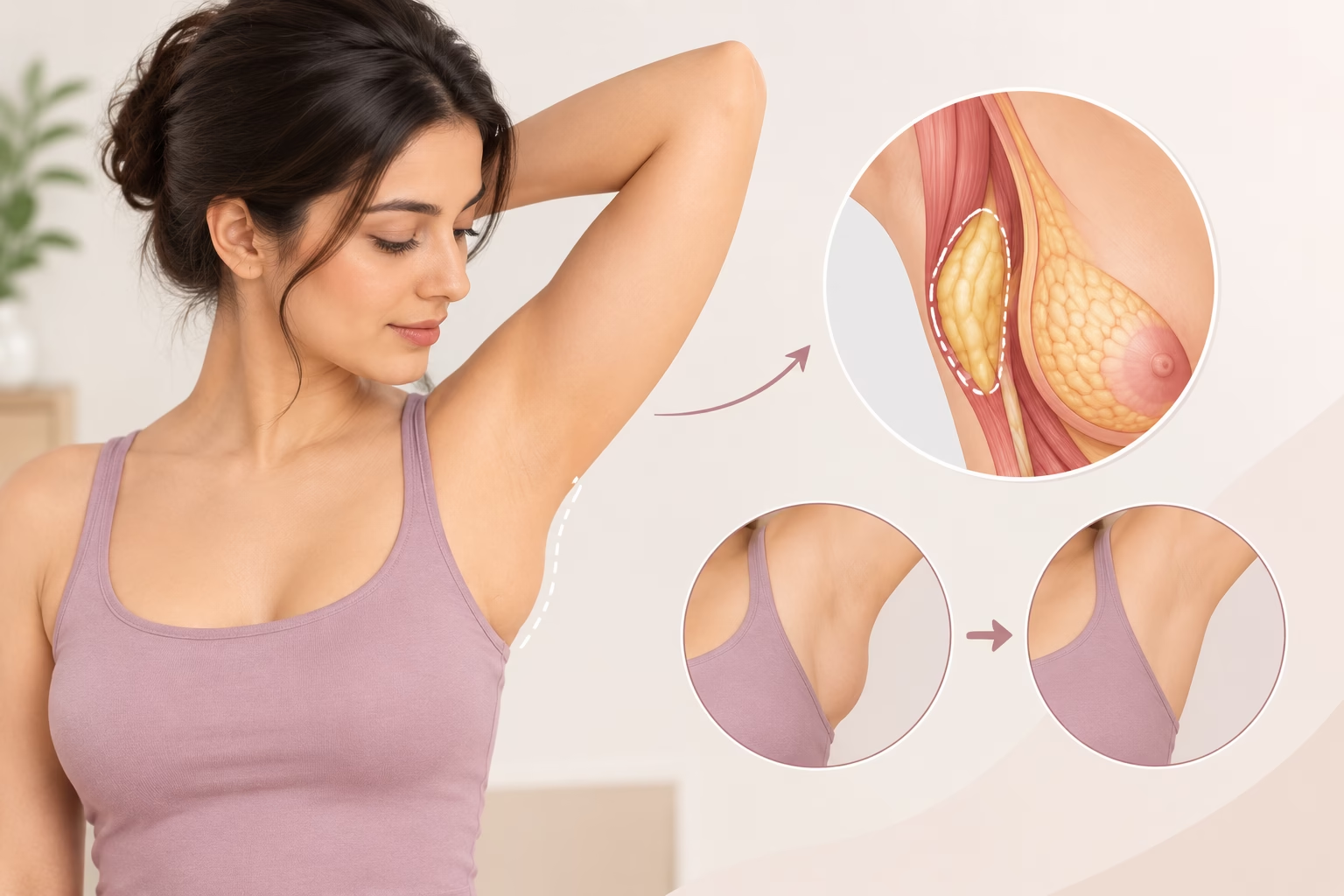
An underarm bulge is often assumed to be stubborn fat. However, not every fullness or lump in the armpit is caused by excess body fat.
Some women have accessory or axillary breast tissue, which is breast tissue located outside the usual breast area, most commonly in the underarm or axilla.
For some people, it causes no problems. For others, the tissue may become more noticeable during puberty, pregnancy, breastfeeding, weight changes or hormonal fluctuations. It may also cause discomfort while wearing fitted clothing, exercising or moving the arms.
If you are considering axillary breast tissue removal in Mumbai, the first step is determining what is actually causing the underarm fullness.
Dr. Kunal Sayani, MBBS, MS, MCh and DrNB (Plastic Surgery), provides personalised assessment and breast surgery consultations at his clinic in Vile Parle West, Mumbai.
What Is Axillary or Accessory Breast Tissue?
Accessory breast tissue is breast tissue that develops outside the normal breast location.
During development before birth, breast tissue forms along an embryological structure often referred to as the mammary or “milk” line. Most of this tissue normally regresses, but in some people a portion remains outside the usual breast area.
The axilla, or underarm, is the most common location for accessory breast tissue. Medical literature reports that accessory breast tissue is a recognised developmental variation and may contain glandular breast tissue as well as fatty tissue.
It can occur on:
- One side
- Both sides
- One side more prominently than the other
The appearance can range from a small area of fullness to a more noticeable underarm bulge.
Is an Underarm Bulge Always Accessory Breast Tissue?
No.
Several different conditions can cause swelling or fullness in the underarm.
These can include:
- Localised body fat
- Accessory breast tissue
- Lipoma
- Cyst
- Enlarged lymph node
- Skin or soft-tissue conditions
- A combination of glandular breast tissue and fat
Because these conditions require different approaches, it is important not to self-diagnose an underarm lump based only on appearance.
A physical examination can help determine whether the area behaves like accessory breast tissue, fatty tissue or another type of lump.
Imaging such as ultrasound may sometimes be recommended when clarification is required. Accessory breast tissue can be identified with imaging modalities including ultrasound and mammography when clinically appropriate.
How Can You Tell Axillary Breast Tissue From Underarm Fat?
This is one of the most common questions among patients with underarm fullness.
Unfortunately, there is no reliable home test that can always distinguish the two.
Underarm fat
Fatty fullness may:
- Change with overall weight gain or loss
- Feel relatively soft
- Blend into surrounding body fat
- Be associated with fat in other areas
Accessory breast tissue
Accessory breast tissue may:
- Remain despite weight loss
- Become more noticeable during pregnancy or breastfeeding
- Change with hormonal cycles
- Cause tenderness or swelling
- Have a more defined area of fullness
However, appearance alone is not enough to make a definite diagnosis.
Some patients have both fat and glandular breast tissue in the axillary area, so treatment may need to address more than one component.
Why Can Axillary Breast Tissue Become More Noticeable During Pregnancy?
Accessory breast tissue can respond to hormonal changes because it contains breast tissue.
Some women first become aware of underarm fullness during:
- Puberty
- Pregnancy
- Breastfeeding
- Menstrual cycles
The tissue can become enlarged, swollen or tender during periods of hormonal change. Research has documented symptoms including swelling, discomfort and tenderness in people with accessory breast tissue.
After pregnancy and breastfeeding, some of the fullness may reduce.
However, residual glandular tissue, excess fat or stretched skin may remain.
This is why surgery should not automatically be planned while the body is still undergoing major pregnancy or breastfeeding-related changes.
Does Exercise Remove Axillary Breast Tissue?
Exercise can help reduce overall body fat and improve upper-body muscle tone.
However, exercise cannot selectively remove established glandular breast tissue.
If the underarm bulge is primarily caused by excess fat, overall weight reduction may improve its appearance.
If the fullness is caused largely by accessory breast tissue, it may remain despite:
- Weight loss
- Strength training
- Cardio
- Arm exercises
- Chest exercises
A consultation can help determine which type of tissue is creating the contour concern before considering treatment.
When Should Axillary Breast Tissue Be Evaluated?
Accessory breast tissue itself is a recognised developmental variation and does not automatically require removal.
A medical assessment may be appropriate when you notice:
- A new underarm lump
- Increasing size
- Persistent pain
- Significant asymmetry
- Changes in the skin
- Unexplained swelling
- A firm or unusual lump
- Changes that do not settle
Breast conditions that affect normally positioned breast tissue can also occur within accessory breast tissue, which is another reason an unexplained or changing axillary lump should be properly assessed rather than assumed to be cosmetic.
Most underarm lumps are not necessarily serious, but appropriate evaluation is important before planning cosmetic removal.
When May Axillary Breast Tissue Removal Be Considered?
Removal may be considered when accessory breast tissue causes functional or aesthetic concerns.
Common reasons patients seek consultation include:
Persistent Underarm Bulging
The tissue may create fullness that remains noticeable even when body weight is stable.
Difficulty With Clothing
Underarm tissue may become visible around:
- Sleeveless tops
- Blouses
- Bras
- Dresses
- Fitted clothing
Discomfort or Irritation
The tissue may rub against clothing or the upper arm and create discomfort during movement.
Exercise Difficulties
Some patients find that significant axillary tissue interferes with certain arm movements or becomes uncomfortable while exercising.
Hormonal Swelling or Tenderness
The tissue may become uncomfortable during hormonal changes.
Asymmetry
One underarm may appear significantly fuller than the other.
The decision to remove the tissue should be based on the patient’s symptoms, anatomy and diagnosis rather than its presence alone.
How Is Axillary Breast Tissue Removed?
There is no single technique that is appropriate for every patient.
Treatment depends on what is creating the underarm fullness.
The surgeon evaluates:
- Amount of glandular tissue
- Amount of fat
- Skin quality
- Degree of skin excess
- Position of the tissue
- Underarm contour
- Symmetry
- Previous surgery
- Scar considerations
Depending on the anatomy, treatment may involve surgical excision, liposuction or a combination of techniques. Published plastic-surgery literature describes both excision and liposuction-based approaches depending on tissue composition and skin characteristics.
When Is Surgical Excision Required?
Excision involves surgically removing unwanted tissue through an incision.
It may be more appropriate when there is a significant amount of:
- Firm glandular tissue
- Accessory breast tissue
- Excess skin
- Tissue that cannot be adequately addressed through fat removal alone
The incision and amount of tissue removed depend on the patient’s anatomy.
An important part of planning is balancing adequate tissue removal with scar position and the natural contour between the breast, chest and underarm.
Can Liposuction Remove an Underarm Breast Bulge?
Sometimes.
Liposuction primarily removes fatty tissue.
It may be helpful when the axillary fullness contains a significant fatty component and the skin is capable of contracting appropriately.
However, liposuction does not reliably remove substantial glandular breast tissue.
If glandular tissue is present, excision may be necessary.
This is why simply requesting “underarm liposuction” without first determining the tissue composition may not address the actual problem.
Can Liposuction and Excision Be Combined?
Yes, in selected cases.
Some patients have a mixture of:
- Glandular tissue
- Excess fat
- Skin laxity
A combined approach may therefore sometimes be considered to improve both tissue removal and overall contour.
The appropriate technique should be selected only after physical examination.
Will Axillary Breast Tissue Removal Leave a Scar?
Any surgical excision requires an incision and therefore produces a scar.
The final scar depends on factors including:
- Amount of tissue removed
- Incision length
- Skin quality
- Individual healing
- Surgical technique
- Wound care
- Scar tendency
A plastic surgeon plans the incision with both tissue access and scar position in mind.
However, patients should be cautious of claims of completely “scarless” accessory breast tissue removal.
A scar can often become less noticeable as it matures, but no surgical scar can be guaranteed to disappear completely.
What Is Recovery Like After Axillary Breast Tissue Removal?
Recovery varies according to the extent of surgery.
Someone undergoing limited treatment of a small area may recover differently from someone requiring larger excision and skin removal.
Temporary symptoms can include:
- Swelling
- Bruising
- Tenderness
- Tightness
- Temporary altered sensation
- Mild restriction in comfortable arm movement
Patients may be advised to restrict strenuous upper-body activity while healing.
Your surgeon should provide personalised instructions regarding:
- Showering
- Dressings
- Arm movement
- Sleeping position
- Driving
- Office work
- Exercise
- Weight training
- Scar care
- Follow-up appointments
Recovery should be guided by wound healing and the procedure performed rather than by a fixed timeline found online.
When Can You Return to the Gym?
Walking and light daily activity may usually return before heavy exercise.
Activities that place significant tension across the chest and underarm area may need to be restricted initially.
These can include:
- Push-ups
- Pull-ups
- Heavy chest exercises
- Shoulder training
- Heavy weight lifting
- Swimming
- High-intensity exercise
Your surgeon should clear you individually before restarting strenuous training.
Can Axillary Breast Tissue Come Back After Removal?
The tissue that has been surgically removed does not simply regenerate in the same way.
However, the appearance of the area can still change due to:
- Significant weight gain
- Pregnancy
- Hormonal changes
- Ageing
- Changes in skin elasticity
The result also depends on how much glandular tissue, fat and skin were present initially and which components were treated.
Maintaining a relatively stable weight can help preserve body-contouring results.
Is Axillary Breast Tissue the Same as a Lipoma?
No.
A lipoma is a benign growth composed primarily of fat cells.
Accessory breast tissue contains breast tissue and originates differently.
They may occasionally look similar from the outside, especially when located in the underarm.
If you have an unexplained soft lump rather than broad underarm fullness, read When Should a Lipoma Be Removed? on Dr. Kunal Sayani’s website.
Also internally link readers to the website’s Sebaceous Cyst vs Lipoma guide where appropriate.
The important point is that a lump should be diagnosed before removal rather than labelled based only on appearance.
Axillary Breast Tissue After Pregnancy
Pregnancy can make accessory breast tissue particularly noticeable.
After pregnancy, a patient may experience a combination of:
- Underarm breast tissue
- Breast sagging
- Loss of breast volume
- Changes in breast size
- Abdominal skin laxity
- Localised fat deposits
Treatment does not necessarily need to address all of these concerns.
Each area should be assessed independently.
Patients with broader post-pregnancy concerns can also read the website guide on Mommy Makeover in Mumbai and Post-Pregnancy Body Contouring.
This creates a natural internal link between this article and the post-pregnancy body-contouring content without targeting the same keyword.
Choosing a Plastic Surgeon for Axillary Breast Tissue Removal in Mumbai
Treatment of accessory breast tissue is not simply about reducing an underarm bulge.
The surgeon needs to consider:
- Breast anatomy
- Underarm anatomy
- Amount of gland and fat
- Skin excess
- Symmetry
- Scar placement
- Shoulder movement
- Overall breast-to-underarm contour
When choosing a surgeon, patients should consider formal plastic surgery qualifications, surgical experience, realistic communication, facility standards and post-operative follow-up.
Dr. Kunal Sayani is an MBBS, MS, MCh and DrNB-qualified Plastic & Aesthetic Surgeon practising in Mumbai.
Internally link this section to the About Dr. Kunal Sayani page to strengthen surgeon authorship and expertise signals.
Axillary Breast Tissue Removal in Vile Parle, Mumbai
Dr. Kunal Sayani provides consultations for breast and body-contouring concerns at his clinic in Vile Parle West, Mumbai.
Clinic Address:
501/502, Sapphire Plaza, Dadabhai Road, Swami Vivekananda Road, Vile Parle West, Mumbai, Maharashtra 400056
The location is accessible for patients travelling from Vile Parle, Andheri, Juhu, Santacruz, Khar, Bandra and other parts of Mumbai.
Get Directions to Dr. Kunal Sayani’s Clinic in Vile Parle West, Mumbai
Link the above text to the official Google Business Profile location.
Frequently Asked Questions About Axillary Breast Tissue
Is accessory breast tissue dangerous?
Accessory breast tissue is a recognised developmental variation and may cause no symptoms. However, any new, changing or unexplained underarm lump should be medically evaluated rather than automatically assumed to be accessory breast tissue.
Can axillary breast tissue disappear with weight loss?
If part of the fullness is caused by fat, weight loss may reduce it. Glandular accessory breast tissue may remain even after significant weight reduction.
Why did my underarm breast tissue increase during pregnancy?
Accessory breast tissue can respond to hormonal changes similarly to normally positioned breast tissue and may therefore become more prominent during pregnancy or breastfeeding.
Can accessory breast tissue occur on only one side?
Yes. It can occur on one or both sides, and the amount of tissue may differ between sides.
Can liposuction alone remove accessory breast tissue?
Liposuction can address fatty tissue but may not adequately remove dense glandular breast tissue. The treatment depends on the tissue composition.
Is accessory breast tissue removal the same as breast reduction?
No. Breast reduction primarily reduces normally positioned breast tissue, while accessory breast surgery addresses breast tissue located outside the usual breast area.
Does accessory breast tissue always need to be removed?
No. Tissue that causes no symptoms or concerns may not require surgery. Treatment should be based on diagnosis, symptoms and individual preference.
Will axillary breast removal improve the underarm contour?
Removing appropriately selected excess tissue can improve the contour, but the result depends on the amount of gland, fat, skin laxity and individual anatomy.
Will there be a visible scar?
Surgical excision produces a scar. Scar length and position depend on the amount and type of tissue requiring removal.
Which doctor should I consult for axillary breast tissue removal in Mumbai?
A qualified surgeon should first confirm what is causing the underarm fullness. When surgical contour and scar placement are significant concerns, consultation with a qualified plastic surgeon may be appropriate.
Consult Dr. Kunal Sayani for Axillary Breast Tissue Removal in Mumbai
If you have persistent underarm fullness, discomfort or a lump that you believe may be accessory breast tissue, the first step is a proper clinical assessment.
Not every underarm bulge requires surgery, and not every underarm bulge is caused by breast tissue.
Dr. Kunal Sayani evaluates the tissue, breast anatomy, skin quality and overall underarm contour before discussing whether observation, further evaluation or surgery may be appropriate.
Dr. Kunal Sayani
MBBS, MS, MCh, DrNB (Plastic Surgery)
Clinic:
501/502, Sapphire Plaza, Dadabhai Road, Swami Vivekananda Road, Vile Parle West, Mumbai, Maharashtra 400056
Phone: +91 99672 67567
Get Directions to Dr. Kunal Sayani’s Clinic in Vile Parle West, Mumbai
Leave a Reply