
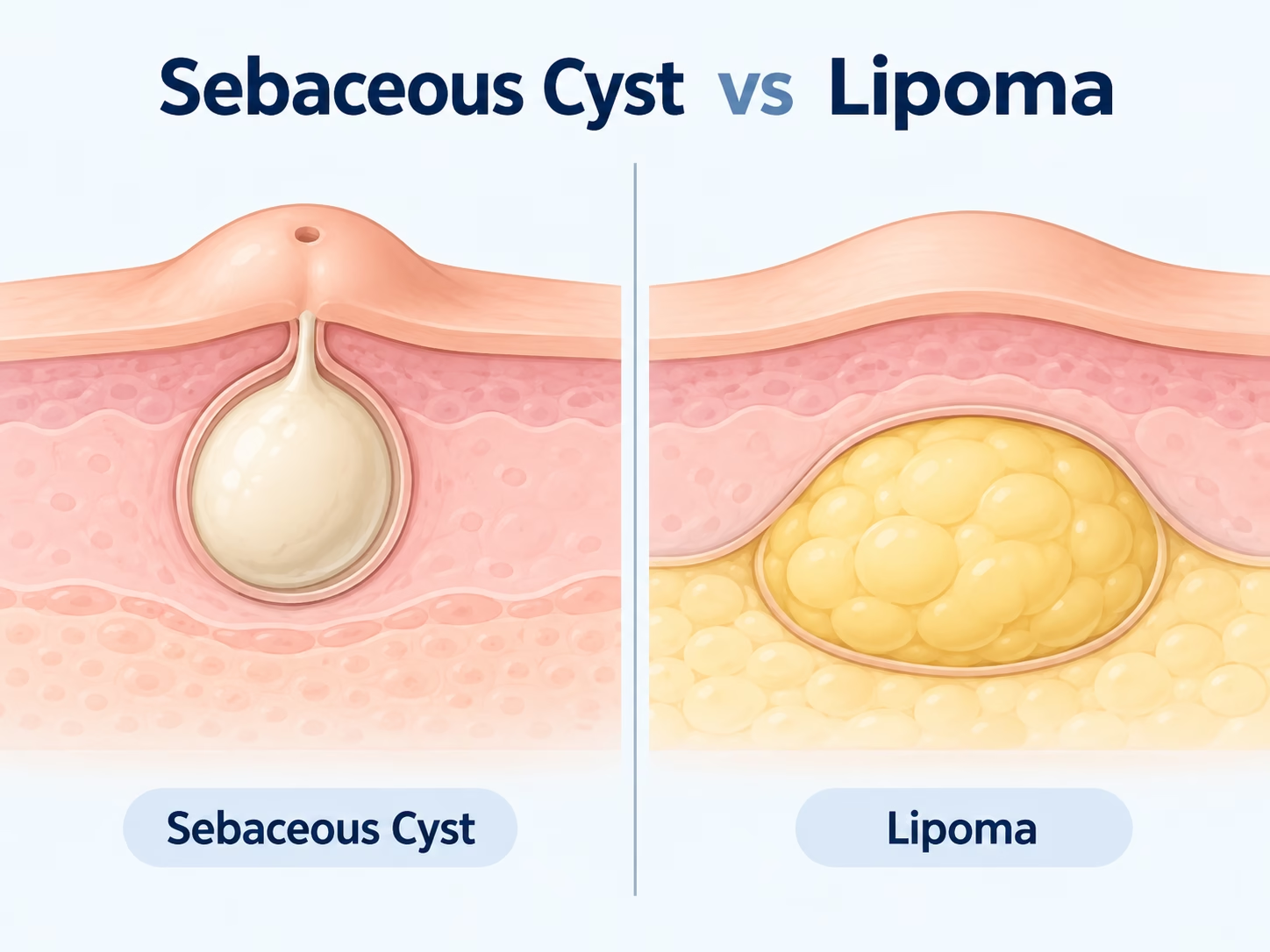
Finding a lump under your skin can be concerning, especially when you are unsure whether it is a cyst, lipoma or another type of growth.
Two common causes of slowly developing lumps beneath or within the skin are sebaceous cysts and lipomas. Although they can sometimes look similar from the outside, they develop from different tissues and may require different treatment approaches.
A lipoma is generally a soft growth composed of fatty tissue beneath the skin. What is commonly called a sebaceous cyst is often an epidermoid or epidermal inclusion cyst containing keratin and surrounded by a cyst wall.
Understanding the differences can be useful, but a new or changing lump should not be diagnosed solely by appearance or by checking symptoms online.
If you are looking for sebaceous cyst removal in Mumbai or are unsure whether a lump may be a lipoma, an examination can help determine the appropriate next step.
Dr. Kunal Sayani offers both Sebaceous Cyst Removal in Mumbai and Lipoma Removal Surgery in Mumbai.
What Is a Sebaceous Cyst?
The term “sebaceous cyst” is commonly used to describe a benign cyst developing underneath the skin.
Many of these lumps are actually epidermoid or epidermal inclusion cysts rather than true cysts originating from sebaceous glands.
They can contain keratin, a material naturally produced by skin cells.
Sebaceous or epidermoid cysts commonly develop on areas such as:
- Face
- Scalp
- Neck
- Back
- Chest
- Behind the ears
- Other areas of the body
A cyst may remain small and painless for a long period.
However, it can sometimes become:
- Enlarged
- Inflamed
- Red
- Painful
- Tender
- Infected
- Recurrently swollen
Some cysts may also discharge material if they rupture or develop an opening to the skin.
You can learn more about surgical treatment on Dr. Kunal Sayani’s Sebaceous Cyst Removal page.
What Is a Lipoma?
A lipoma is a benign growth made primarily of fat cells.
It typically develops beneath the skin and often grows slowly.
Common areas include:
- Neck
- Shoulders
- Back
- Arms
- Torso
- Thighs
Lipomas often feel soft or rubbery and may move slightly when pressure is applied.
Most are painless.
However, larger lipomas or those positioned in uncomfortable locations may cause pressure, irritation or cosmetic concern.
Dr. Kunal Sayani also provides Lipoma Removal Surgery in Mumbai for patients whose lumps require assessment or removal.
Sebaceous Cyst vs Lipoma: What Is the Main Difference?
The primary difference is what the lump is made of.
Sebaceous or Epidermoid Cyst
A cyst is a sac-like structure containing keratin or other material.
Lipoma
A lipoma is a growth composed of fatty tissue.
Because they originate differently, the way they feel, behave and are removed can also differ.
How Does a Sebaceous Cyst Feel?
A cyst may feel like a round or dome-shaped lump underneath or within the skin.
Depending on its size and condition, it may feel:
- Firm
- Smooth
- Well-defined
- Slightly mobile
- Tender if inflamed
Some cysts have a small central opening or punctum visible on the skin.
If inflammation or infection develops, the lump may become painful, red or warm.
How Does a Lipoma Feel?
A typical lipoma often feels:
- Soft
- Rubbery
- Mobile beneath the skin
- Relatively painless
Lipomas are often located slightly deeper beneath the skin than superficial cysts.
However, texture alone is not enough to accurately diagnose every lump.
Some cysts can feel soft, while some deeper lipomas may feel firmer.
Sebaceous Cyst vs Lipoma: Quick Comparison
A Sebaceous Cyst May:
- Develop closer to the skin surface
- Have a visible central opening
- Become inflamed
- Become infected
- Produce discharge
- Become painful
- Recur if its wall remains behind
A Lipoma May:
- Feel softer
- Sit deeper beneath the skin
- Move slightly when pressed
- Grow slowly
- Remain painless
- Not usually become infected
These are general patterns and should not be used as a substitute for medical examination.
Can a Sebaceous Cyst Become Infected?
Yes.
A cyst can become inflamed or infected.
Symptoms can include:
- Increased swelling
- Redness
- Pain
- Tenderness
- Warmth
- Discharge
- Increasing size
An inflamed lump should not be repeatedly squeezed or punctured at home.
Doing so can increase irritation, introduce infection and make subsequent treatment more difficult.
If a cyst becomes painful, red or repeatedly inflamed, medical assessment is advisable.
Can a Lipoma Become Infected?
A typical lipoma does not usually become infected because it is made of fatty tissue rather than being a cyst connected to the skin surface.
Therefore, sudden redness, discharge or significant inflammation are less typical of a straightforward lipoma.
Any lump that suddenly changes should be medically assessed.
Why Does a Sebaceous Cyst Keep Coming Back?
A cyst can recur if the contents are emptied but the surrounding cyst wall or capsule remains.
This is why simply squeezing or draining a cyst does not necessarily provide permanent treatment.
When surgical removal is appropriate, the goal is generally to remove the cyst together with its wall.
Complete removal may reduce the likelihood of recurrence.
Dr. Kunal Sayani’s Sebaceous Cyst Removal in Mumbai focuses on removal of the cyst wall while also considering scar placement and wound healing.
Can You Pop a Sebaceous Cyst at Home?
It is generally not advisable to attempt to squeeze, cut or puncture a suspected cyst yourself.
Doing so can result in:
- Infection
- Bleeding
- Increased inflammation
- Scarring
- Incomplete emptying
- Recurrence
- Difficulty removing the cyst later
Even if material is released, the cyst wall can remain underneath the skin.
The lump may therefore return.
Does a Lipoma Need to Be Removed?
Not necessarily.
Many small, painless and stable lipomas can simply be observed after appropriate assessment.
Removal may be considered when the lipoma:
- Continues growing
- Causes discomfort
- Creates pressure
- Interferes with movement
- Becomes cosmetically noticeable
- Creates uncertainty about diagnosis
For a more detailed explanation, read When Should a Lipoma Be Removed? A Guide to Lipoma Removal in Mumbai.
Does Every Sebaceous Cyst Need to Be Removed?
No.
A small, painless and stable cyst may not always require immediate surgical removal.
However, removal may be considered when the cyst:
- Repeatedly becomes inflamed
- Causes pain
- Becomes infected
- Continues increasing in size
- Produces recurrent discharge
- Is located in an uncomfortable area
- Causes cosmetic concern
- Interferes with daily activities
The appropriate decision depends on the individual cyst and its location.
When Should You See a Doctor About a Skin Lump?
Any new or unexplained lump deserves attention if you are uncertain about what it is.
Medical assessment becomes particularly important if the lump:
- Grows rapidly
- Becomes painful
- Feels unusually hard
- Becomes fixed in place
- Develops redness
- Produces discharge
- Changes suddenly
- Recurs repeatedly
- Causes numbness or other symptoms
- Has an uncertain diagnosis
These features do not automatically mean that a serious condition is present.
They simply indicate that the lump should not be self-diagnosed.
Can a Doctor Tell the Difference Between a Lipoma and Cyst by Examination?
Many typical cysts and lipomas can be suspected based on clinical examination.
The doctor may assess:
- Location
- Size
- Depth
- Texture
- Mobility
- Skin changes
- Presence of a punctum
- Tenderness
- Growth history
In some situations, further imaging or testing may be recommended when the diagnosis is uncertain or when the lump has unusual characteristics.
How Is a Sebaceous Cyst Removed?
Surgical removal generally involves creating a small incision and carefully separating the cyst from surrounding tissue.
The objective is to remove both:
- Cyst contents
- Cyst wall or capsule
Removing the entire wall is important because leaving part of it behind can increase the chance of recurrence.
The incision is then closed appropriately.
For many uncomplicated cysts, removal can be performed as an outpatient procedure under local anaesthesia.
The exact technique depends on the cyst’s:
- Size
- Location
- Depth
- Degree of inflammation
- Previous infection
- Previous treatment
How Is a Lipoma Removed?
Lipoma removal also generally involves a surgical incision.
The surgeon identifies and removes the fatty growth while protecting the surrounding tissues.
Small superficial lipomas may often be removed under local anaesthesia.
Larger or deeper lipomas can require a different approach.
Learn more about the procedure on the Lipoma Removal Surgery in Mumbai page.
Is Sebaceous Cyst Removal Painful?
Local anaesthesia is commonly used for uncomplicated cyst removal so that the treatment area is numbed during the procedure.
Patients may experience some temporary tenderness afterward.
The degree of discomfort varies according to:
- Size of cyst
- Location
- Degree of inflammation
- Complexity of removal
Your surgeon can explain what to expect after examining the cyst.
How Long Does Sebaceous Cyst Removal Take?
Small, uncomplicated cysts can often be removed relatively quickly.
However, procedure time varies according to:
- Size
- Location
- Depth
- Previous inflammation
- Previous infection
- Scar tissue
- Complexity
Dr. Kunal Sayani’s current cyst-removal information notes that many procedures are relatively short outpatient treatments.
Can an Infected Cyst Be Removed Immediately?
Treatment depends on the degree of inflammation or infection.
Significant inflammation can sometimes make complete cyst-wall removal more difficult because tissues may become fragile or poorly defined.
The surgeon may therefore decide on the appropriate timing and treatment approach after examining the area.
Do not delay assessment simply because the cyst is inflamed.
Will Sebaceous Cyst Removal Leave a Scar?
Any surgical incision can leave a scar.
The eventual appearance depends on several factors, including:
- Cyst size
- Cyst location
- Previous inflammation
- Skin characteristics
- Incision length
- Surgical closure
- Individual healing
Removing a repeatedly inflamed or very large cyst may sometimes require a larger incision than removing a small, uncomplicated cyst.
Early evaluation can therefore be useful when a cyst repeatedly becomes troublesome.
Plastic surgical planning also considers where the incision is placed and how the wound is closed.
Will Lipoma Removal Leave a Scar?
Lipoma removal also requires an incision.
Scar size depends largely on:
- Lipoma size
- Depth
- Location
- Surgical approach
A plastic surgeon may plan the incision according to natural skin lines or less conspicuous locations when clinically possible.
However, completely scar-free removal cannot be guaranteed.
Which Has a Higher Chance of Recurrence?
Both cysts and lipomas can potentially recur, although recurrence is generally less likely after complete removal.
For a cyst, complete removal of the cyst wall is particularly important.
If only the contents are drained, the cyst may form again.
For a lipoma, complete removal of the fatty growth usually provides long-term treatment, although some people can develop other lipomas elsewhere.
Is a Sebaceous Cyst Cancerous?
Typical epidermoid or so-called sebaceous cysts are generally benign.
However, you should not assume that every skin lump is a harmless cyst without appropriate evaluation.
A rapidly changing, unusual or uncertain lump should be examined.
Is a Lipoma Cancerous?
Typical lipomas are benign fatty growths.
However, not every fatty or deep soft-tissue lump is necessarily a simple lipoma.
This is one reason why unusually large, rapidly growing, painful, firm or deep lumps deserve professional assessment.
Sebaceous Cyst vs Acne: What Is the Difference?
A cyst underneath the skin can sometimes be confused with severe acne.
Acne lesions typically develop in association with hair follicles and may occur as multiple pimples, blackheads, whiteheads or inflammatory lesions.
An epidermoid cyst is a more defined sac-like lump underneath the skin and may persist for much longer.
Repeatedly treating a cyst like a pimple by squeezing it may increase inflammation and scarring.
Sebaceous Cyst vs Abscess
A cyst and an abscess are not the same thing.
An abscess is a collection of pus associated with infection.
A cyst may become infected and develop abscess-like features, but the underlying cyst wall can remain.
This is why the long-term treatment strategy can differ after acute inflammation settles.
Sebaceous Cyst vs Lipoma on the Scalp
Both lumps can occur around the scalp, although cysts are particularly common there.
Scalp lumps can be noticeable when:
- Washing hair
- Combing
- Wearing helmets
- Cutting hair
Any scalp lump that grows or repeatedly becomes irritated should be evaluated.
Because the scalp is a visible area when hair is short or thin, incision planning can also be important.
Sebaceous Cyst on the Face
Facial cysts create an additional cosmetic consideration because both the cyst and resulting scar may be visible.
Repeated squeezing or inflammation can increase skin damage.
For this reason, patients considering sebaceous cyst removal on the face in Mumbai may prefer evaluation before the cyst becomes repeatedly infected or significantly enlarged.
A plastic surgeon considers both complete removal and scar placement.
Sebaceous Cyst Behind the Ear
Cysts can sometimes develop behind or around the ear.
Repeated irritation from spectacles, headphones, helmet straps or other pressure may make the area uncomfortable.
A persistent lump in this location should be assessed before assuming it is a cyst.
What Happens After Cyst Removal?
Post-procedure instructions depend on the location and size of the cyst.
General care may include:
- Keeping the wound clean
- Protecting the incision
- Avoiding unnecessary pressure
- Following dressing instructions
- Returning for follow-up when advised
- Avoiding activities that place excessive tension on the incision
Your surgeon will provide instructions according to the exact procedure performed.
When Can You Return to Work?
Many small cyst removals have relatively limited downtime.
Return to work depends on:
- Cyst location
- Procedure size
- Type of work
- Wound requirements
- Individual healing
Someone with a small cyst removed from an area not exposed to repeated movement may return to routine activities sooner than a patient whose procedure involves a larger or more mobile area.
How Much Does Sebaceous Cyst Removal Cost in Mumbai?
The cost of sebaceous cyst removal in Mumbai varies because not every cyst requires the same procedure.
Factors can include:
- Size of the cyst
- Location
- Depth
- Number of cysts
- Previous infection
- Previous surgery
- Complexity
- Anaesthesia
- Surgical facility requirements
A small uncomplicated cyst is different from a large, recurrent or previously infected cyst.
An accurate cost estimate is therefore best provided after examination.
How Much Does Lipoma Removal Cost in Mumbai?
Lipoma-removal cost also varies according to the size, number, location and depth of the growth.
Larger or deeper lipomas may require more extensive surgery than small superficial ones.
Patients considering treatment can first read When Should a Lipoma Be Removed? and the dedicated Lipoma Removal Surgery page.
Why Consider a Plastic Surgeon for Cyst Removal?
Many cysts are minor surgical problems, but cosmetic considerations can become particularly important when they occur on visible areas such as:
- Face
- Neck
- Scalp
- Chest
A plastic surgeon is trained in:
- Tissue handling
- Incision planning
- Wound closure
- Scar management
The primary goal remains safe and complete treatment, while scar placement and cosmetic healing can also be considered.
You can learn more about Dr. Kunal Sayani’s qualifications and experience.
Sebaceous Cyst Removal in Vile Parle, Mumbai
Patients searching locally may use terms such as:
- Sebaceous cyst removal in Mumbai
- Cyst removal in Vile Parle
- Sebaceous cyst treatment near Andheri
- Cyst removal surgeon near Juhu
- Skin lump removal Mumbai
- Lipoma removal in Mumbai
- Plastic surgeon for cyst removal near me
Clinic accessibility can be useful because treatment may involve examination, removal and follow-up wound care.
Dr. Kunal Sayani’s clinic is located at:
501/502, Sapphire Plaza, Dadabhai Road, Swami Vivekananda Rd, Vile Parle West, Mumbai, Maharashtra.
Get Directions to Dr. Kunal Sayani’s Clinic in Vile Parle, Mumbai
The clinic is accessible to patients travelling from Vile Parle, Andheri, Juhu, Santacruz, Khar, Bandra, Goregaon and other parts of Mumbai.
Clinic location is useful for convenience, but proper diagnosis, complete removal where appropriate and careful surgical technique remain more important considerations.
Frequently Asked Questions About Sebaceous Cysts and Lipomas
How can I tell whether my lump is a cyst or lipoma?
Cysts may be closer to the skin surface and can sometimes have a central opening or become inflamed. Lipomas tend to feel softer and more mobile. A clinical examination is the safest way to distinguish them.
Can a sebaceous cyst go away on its own?
Some cysts may remain small and stable, but an established cyst can persist because its wall remains underneath the skin.
Can I squeeze a sebaceous cyst?
It is best not to squeeze, cut or puncture a suspected cyst yourself because this can lead to infection, inflammation, scarring and recurrence.
Does a cyst need removal if it does not hurt?
Not always. A small, stable and symptom-free cyst may sometimes be observed. Removal may be considered if it grows, becomes repeatedly inflamed or causes cosmetic concern.
Is cyst removal permanent?
Complete removal of the cyst and its wall can provide long-term treatment and reduce the likelihood of recurrence.
Can a lipoma disappear with weight loss?
Weight loss reduces general body fat but does not necessarily make an established lipoma disappear.
Can a cyst turn into a lipoma?
No. They develop from different types of tissue.
Why does my cyst keep filling again?
If a cyst has been squeezed or drained without removing the wall, keratin can accumulate again and cause the lump to return.
Can several cysts be removed together?
Potentially. The decision depends on their number, size, location and the overall extent of treatment.
Should every lump be removed?
No. The first step is identifying what the lump is. Removal is recommended only when medically or cosmetically appropriate.
When Should You Consult a Plastic Surgeon?
Consider an assessment if you have a lump that:
- Keeps increasing in size
- Repeatedly becomes inflamed
- Causes pain
- Produces discharge
- Returns after previous treatment
- Causes cosmetic concern
- Is located on a visible area
- Is interfering with daily activities
- Has an uncertain diagnosis
Consultation does not automatically mean that surgery is necessary.
The first goal is to determine whether the lump appears consistent with a cyst, lipoma or another condition and then discuss the appropriate treatment.
Consult Dr. Kunal Sayani for Sebaceous Cyst Removal in Mumbai
If you have a persistent skin lump, recurrent cyst or swelling that continues to become inflamed, an individual examination can help identify the problem and determine whether removal may be appropriate.
Dr. Kunal Sayani provides Sebaceous Cyst Removal in Mumbai with attention to complete cyst removal, wound closure and scar placement.
If the lump is soft and appears more consistent with a fatty growth, you can also explore Lipoma Removal Surgery in Mumbai or read When Should a Lipoma Be Removed?.
Clinic Address:
501/502, Sapphire Plaza, Dadabhai Road, Swami Vivekananda Rd, Vile Parle West, Mumbai, Maharashtra.
Get Directions to Dr. Kunal Sayani’s Clinic in Vile Parle, Mumbai
You can also visit Dr. Kunal Sayani – Plastic Surgeon in Mumbai to explore available treatments or use the contact page to enquire about a consultation.
Leave a Reply